How to choose
Backpack, tote or sling: choosing the bag you will actually carry
Choose a daily bag from the load you carry: how many liters the contents need, which carry style suits the weight, and what the label must say.
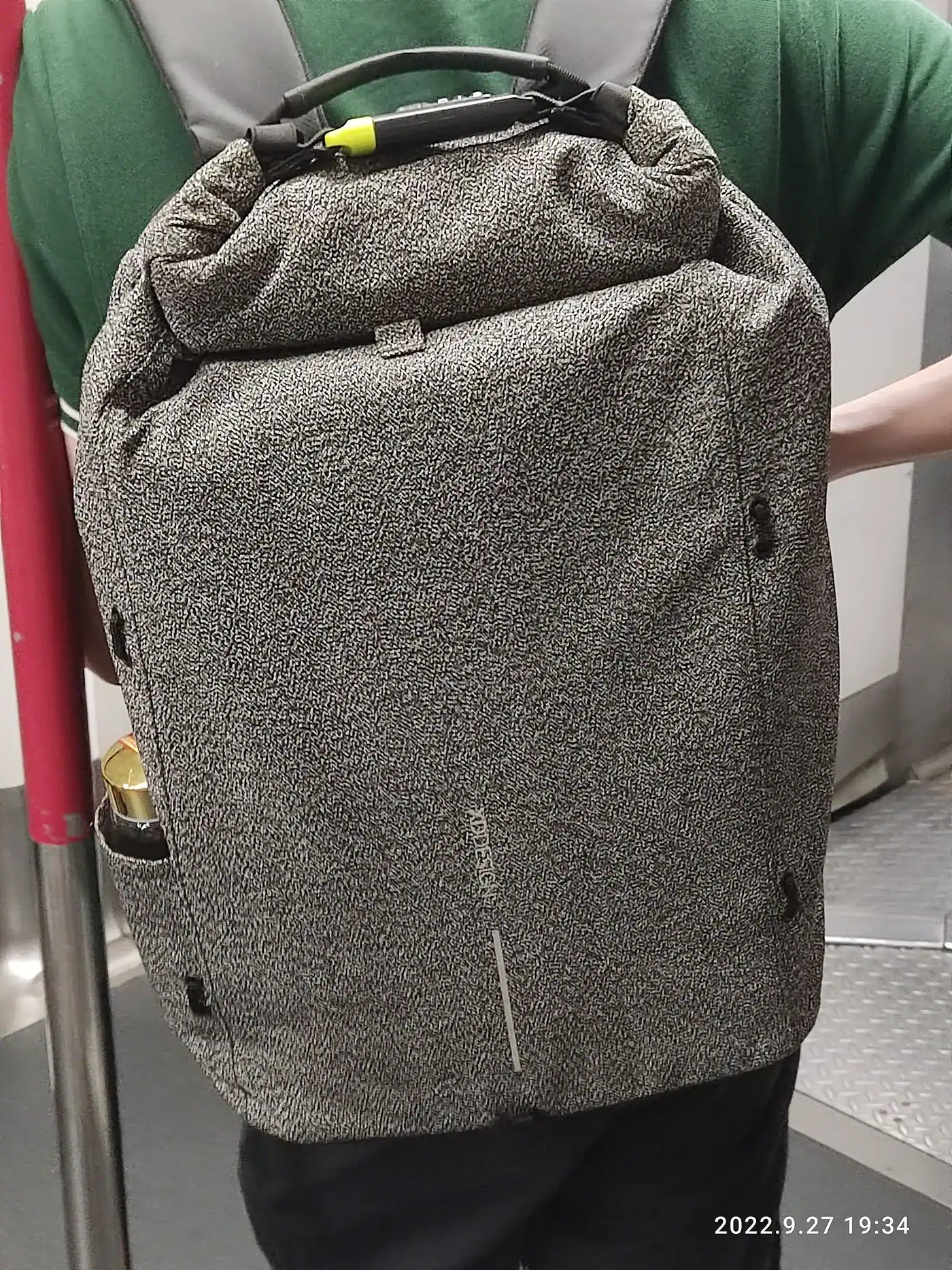
Almost every bag that ends up in a cupboard was bought for a volume rather than for a load. The volume printed on the label is the maker's measurement of empty space; the load is the specific pile of things you put down on the table every evening. Those two numbers meet badly when the pile is tall and narrow and the bag is wide and shallow.
This guide works in the other direction. It starts with the pile, converts it to a volume, then picks a carry style from the weight and an opening from how often you reach into it. Every price below is an example used to show the arithmetic, not a price we are quoting, and no bag here has been tested by us.
Start from what goes in it, not from the shelf
Put everything you carry on a table and measure the pile. A 13 to 14 inch laptop in a sleeve is roughly 13 by 9 by 1 inches; a charger and cable brick is about the size of a fist; a 20 oz bottle is a cylinder you cannot compress. Those three together already dictate the shape of the main compartment more than any feature list does.
Convert the pile into liters by stacking it into a box you can measure, or by filling a known container. Most daily commutes land between 18 and 22 liters once a laptop, charger, notebook, lunch and a bottle are in. Adding a change of clothes or a gym kit pushes it to 26 to 30 liters, and that jump is where a single compartment stops working and a second, separable one starts to matter.
Buy for the load you carry on a normal day, not for the heaviest day of the year. A 30 liter pack carried half empty for 240 days a year to cover 10 days of travel is a worse daily bag than a 20 liter pack plus a folded duffel. The size-fit calculator on this site takes the dimensions of your own pile and returns the volume it occupies.
| What you carry | Volume it occupies | Carry style that suits it |
|---|---|---|
| Phone, wallet, keys, a 20 oz bottle | 5 to 8 liters | Sling or small tote |
| 13 to 14 inch laptop, charger, notebook, lunch, bottle | 18 to 22 liters | Two-strap daypack |
| The above plus a gym kit or a change of clothes | 26 to 30 liters | Commuter pack with a separate lower compartment |
| Two nights away, cabin only | 35 to 40 liters | Travel pack with a clamshell opening |
Volumes here are what the contents occupy. Makers measure their own bags differently, including or excluding outer pockets, so two bags both labelled 22 liters can differ by several liters of usable space.
Two straps, one strap, or handles
Weight decides this, and it decides it quickly. A load split across two shoulders and held close to the spine stays comfortable for a 30 minute walk; the same load on one shoulder becomes a posture problem inside 10 minutes. The crossover in practice sits around 12 lb: below it a sling or tote is a reasonable trade for the speed of access, above it the second strap stops being optional.
A systematic review of school backpack studies indexed in PubMed Central found that most of the papers it examined recommended a load limit of 10 to 15 percent of body weight for schoolchildren. That work is about children rather than adults, so it is a reference point rather than a rule for a commuter, but it is the only published number in this area with a review behind it, and it is a useful ceiling to notice when a daily load creeps upward.
The sternum strap does more than the shoulder padding on most packs. Loaded straps slide outward and off the shoulder, which is the sensation people describe as the bag feeling heavy; a clipped sternum strap holds them in and changes nothing about the weight. A hip belt only earns its buckle if it reaches the top of the hip bone, and on most 20 liter packs it does not.
- Two straps: the load splits and sits against the spine, and it stays tolerable for a walk of 30 minutes or more
- One strap: fast to swing round without taking it off, and uncomfortable above roughly 12 lb
- Handles only: suits a load you set down every few minutes and carry for under 10 minutes at a time
- A sternum strap is worth more than extra shoulder padding, because it stops the straps sliding outward
- A hip belt helps only when it reaches the top of the hip bone; lower than that it adds a buckle and nothing else
Access decides whether you keep using it
Count how many times a day you open the bag. Two or three times suits a top opening; eight or ten times across a commute with several stops does not, because each reach into a top-loader means digging past whatever went in last. This is the single most common reason a well-made bag stops being carried after a month.
A separate laptop entry is a different feature from a laptop sleeve. A sleeve that can only be reached by opening the main compartment costs you the whole unpacking sequence at a security line or a shared desk; a side or back entry reaches the same sleeve without exposing the rest.
Security follows from the same choice. An open tote is instant and holds nothing securely; a roll-top with a buckle is slow and awkward to open behind you on a crowded train, which is exactly what makes it hard for anyone else to open too. Decide which of those two problems you actually have on your route.
| Opening | Reach to the bottom | Suits |
|---|---|---|
| Top drawstring or roll-top | Slowest; everything above comes out first | A bag opened two or three times a day |
| Front panel zip or clamshell | Fastest; the bag lies open flat | A commute with several stops |
| Side or back laptop entry | Reaches the sleeve without opening the main compartment | Security lines and shared desks |
| Open tote | Instant, and nothing inside is secured | Short walks away from crowds |
What the label has to tell you
For anything that looks like leather, the Federal Trade Commission's Leather Guides take the position that the appearance of leather is itself an implied representation that the product is leather. Where all or part of a bag is a non-leather material that looks like leather, the guides say the fact should be disclosed, and they give the wording that does it: not leather, imitation leather, simulated leather, vinyl, vinyl coated fabric or plastic. A bag described only as a leather look is telling you something by what it omits.
For fabric bags, the Textile and Wool Acts labeling requirements run on percentages. Fibers are listed in descending order of predominance by weight, and only fibers that make up 5 percent or more of the fiber weight may be named; anything under that threshold is disclosed as other fiber, with narrow exceptions for wool and for a functionally significant fiber such as 4 percent spandex. The label must also identify the country where the product was processed or manufactured, and the company name or the registered identification number of the firm marketing it.
Read those two things before the marketing copy. A bag whose label names the country of manufacture, an RN number and a fiber breakdown is a bag whose maker can be traced when a zipper fails in year three, which is the point at which the cost-per-wear arithmetic in the budget guide on this site either works or collapses.
The travel days you will use it for
If the bag is also your cabin bag, two separate limits apply and only one of them is national. The Transportation Security Administration's liquids rule is about containers rather than bags: 3.4 ounces or 100 milliliters or less per item, carried in a quart-sized bag. A front pocket that will hold that quart bag flat, and let you pull it out without unpacking, saves a minute at every screening.
Cabin bag dimensions are set by each airline rather than by a security rule, and they are published on each airline's own baggage page. A 35 to 40 liter pack sits near the common limits when it is packed flat and over them when the compression straps are loose, so a pack with side compression is worth more on travel days than one extra liter of volume.
Before you buy
- Stack your daily load on a table and measure it before you look at any bag
- Weigh the loaded pile and decide the carry style from the weight, not from the look
- Count how many times a day you will open the bag and pick the opening from that number
- Check whether the laptop sleeve can be reached without opening the main compartment
- Read the fiber content and country of origin on the label before the marketing copy
- If the bag doubles as a cabin bag, confirm a front pocket holds a quart-sized liquids bag flat
- Put your own price and expected years into the cost-per-wear calculator before comparing two bags
Questions readers ask
- How do I know what volume I actually need?
- Stack what you carry into a cardboard box and measure the box in inches, then multiply length by width by height and divide by 61 to get liters. A typical commute pile comes out at 18 to 22 liters. Doing this once is more reliable than comparing labels, because makers include and exclude outer pockets differently in the figure they print.
- Is a more expensive bag cheaper over time?
- Only if you keep it. At 250 commuting days a year, a $120 bag kept 5 years is 1,250 wears and about 10 cents a wear, while a $45 bag replaced every year is 250 wears and about 18 cents. A $400 bag kept the same 5 years is about 32 cents, so price alone decides nothing until you fix the years.
- Does a laptop compartment need padding on all sides?
- The base matters most, because a bag set down hard transmits the impact straight through. A sleeve that stops 1 to 2 inches short of the bottom seam protects the corner that actually takes the knock. Side padding mostly protects against pressure rather than impact, and a bag that is full rarely needs it.
- What does an RN number on the label tell me?
- It identifies the business that markets, imports or distributes the product, and it is one of the two permitted ways to meet the identity requirement in the textile labeling rules, the other being the company name itself. It does not name the factory, and it is not a quality mark. It does give you a traceable party when you need a repair or a replacement part.
Sources
- Transportation Security Administration — liquids rule (3.4 ounces or 100 millilitres per item, one quart-sized bag) — checked 2026-11-03
- Federal Trade Commission — Leather Guides, 16 CFR Part 24, disclosure of non-leather content — checked 2026-11-03
- Federal Trade Commission — labeling requirements under the Textile and Wool Acts, including the 5 percent fiber rule — checked 2026-11-03
Some links on this site can earn us a commission. That does not change which product a guide recommends, and it adds nothing to your price. Advertising is not enabled on this site yet. When it is, ads will be labelled and kept visually separate from the guides.